The Nanny Was About to Go to Prison for $50,000—Until a 6-Year-Old Girl Spoke Up
The courtroom froze.
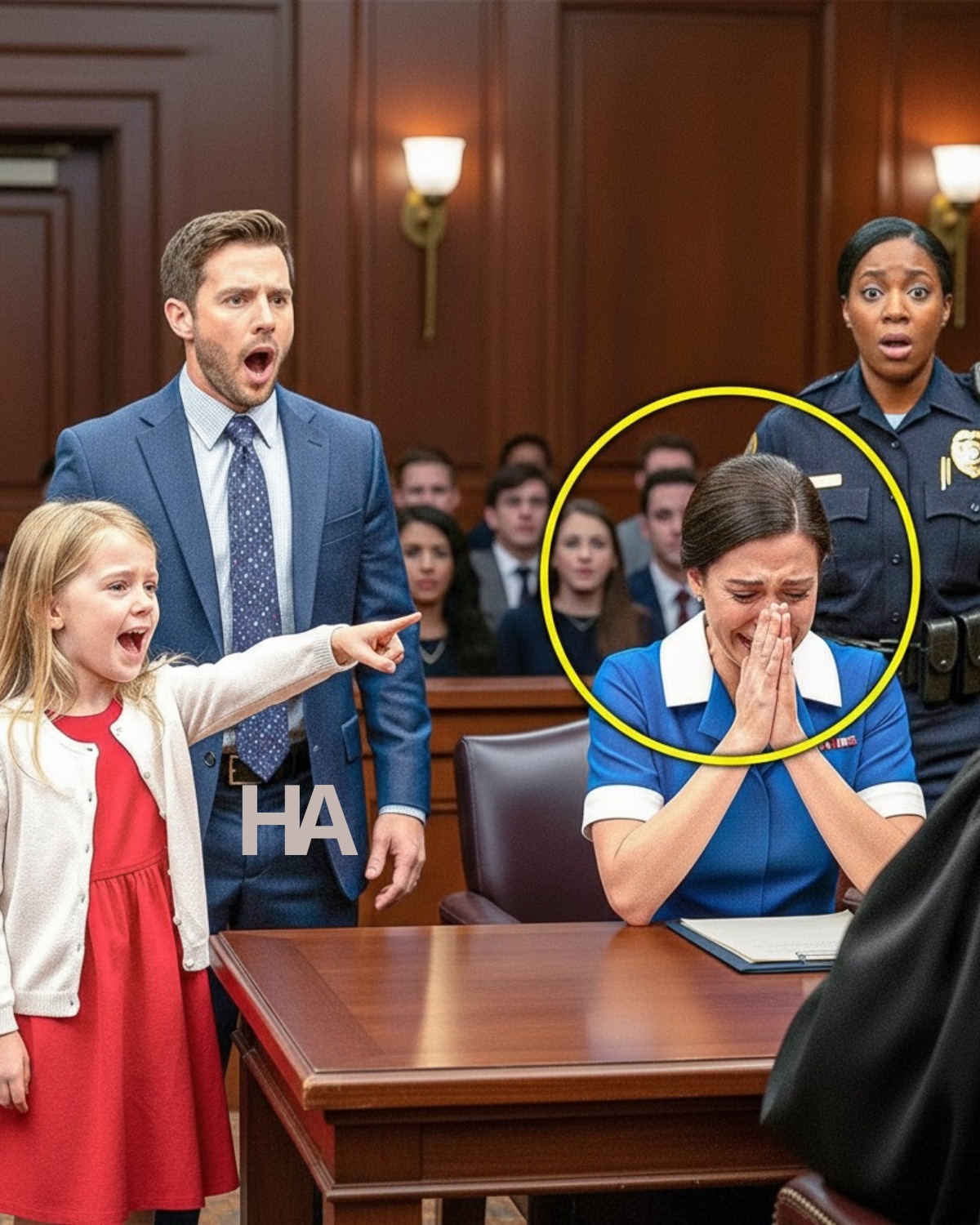
Six-year-old Sofía raised her small hand and pointed toward the gallery with a confidence that didn’t belong to a child her age.
“I saw Mommy put the money in her bag,” she said.
“The red one. The big one. With the gold straps.”
The silence that followed was so heavy it felt physical.
Carolina’s chest tightened as if all the air had been pulled from the room. For weeks, she had heard her name dragged through words like theft, betrayal, guilty. But she never—never—imagined those words would be echoed by the little girl she had raised as if she were her own.
The same little girl who used to run into her arms every afternoon.
Mateo, the defense attorney, swallowed hard before approaching the witness stand.
“Sofía,” he said gently, lowering himself to her level, “you’re safe here. Can you tell us exactly what you saw?”
The girl’s eyes filled with tears, but she didn’t look away.
“Mommy opened the box where she keeps the money,” Sofía whispered.
“I was playing in the hallway. She didn’t see me. She took the bills… a lot of them… and put them in her red bag. Then she went to Carolina’s room. I followed her… I thought we were going to play…”
A collective breath was held across the courtroom.
Adriana—the child’s mother—sat rigid, her jaw clenched so tightly her face had gone pale. Carolina, seated beside Mateo, stared ahead in disbelief. The voice speaking through tears belonged to the same child who once called her name in the middle of the night after a bad dream.
To everyone else, this was testimony.
To Carolina, it felt like her heart was being torn open.
But to understand how they ended up there—how a nanny faced prison over fifty thousand dollars—you had to go back weeks earlier. Back to when life still felt ordinary. Back to when Carolina’s world hadn’t shattered.
Carolina had worked as a live-in nanny for the Domínguez family for three years. Her room was small but warm, its walls covered with drawings Sofía taped up proudly, one after another. She didn’t own expensive clothes or jewelry. What she had was better.
She had Sofía’s laughter.
“Carolina! Look what I made at school!” Sofía would shout, racing down the marble hallway with her backpack half open.
That day, she held up a drawing bursting with color. Two figures were holding hands. Next to them was a massive cat.
“This is you,” Sofía said, pointing to a woman with long hair and a yellow dress.
“This is me. And this is Mr. Whiskers.”
Carolina laughed softly. The cat took up more space in the picture than Sofía’s own mother.
“It’s beautiful, sweetheart,” Carolina said. “We’ll put it on the fridge so everyone can see it.”
“And Mommy?” Sofía asked, almost automatically.
Carolina glanced toward the second floor. Adriana’s office door was closed. Muffled voices leaked through, mixed with the constant tapping of her phone.
“Mommy has a lot of work, honey,” Carolina said, brushing Sofía’s hair back gently.
“But I’m here. How about we make cookies?”
Sofía smiled.
Neither of them knew that in a few weeks, that same child would be standing in a courtroom—
and her words would decide whether Carolina walked free…
or went to prison for a crime she didn’t commit..
The trouble began the night Adriana’s money disappeared.
Fifty thousand dollars in cash—kept in a locked wooden box in her closet—was gone by morning. The police were called before breakfast. Questions were asked before coffee had cooled.
There was no sign of forced entry. No missing jewelry. No broken locks.
Only one person had unrestricted access to the house.
Carolina.
“I would never,” Carolina said, her voice shaking as Adriana stood across from her, arms crossed, eyes cold. “You know me.”
Adriana didn’t answer. She didn’t need to. The silence was accusation enough.
By nightfall, Carolina’s room had been searched. Her suitcase emptied. Her phone seized. When the police found traces of her fingerprints on the money box—fingerprints she’d left countless times while cleaning—it sealed the narrative.
The nanny stole the money.
Sofía cried when Carolina was taken away. She screamed and clung to her leg, begging them not to take “Lina.” Adriana pulled her daughter back, whispering something sharply into her ear.
For days afterward, Sofía asked where Carolina was.
“She lied,” Adriana told her. “She did something bad.”
But children remember what adults forget.
They remember details.
The red bag.
The gold straps.
The night Sofía followed her mother down the hall.
Back in the courtroom, Mateo took a slow breath.
“Your Honor,” he said, steady but urgent, “the defense requests that the court admit the contents of Ms. Domínguez’s red handbag into evidence.”
A murmur rippled through the room.
Adriana’s head snapped up. “That’s ridiculous,” she said sharply. “That bag has already been searched.”
Mateo nodded. “Yes. Once. At the house. Two weeks ago.”
He turned toward the bailiff. “But not since then.”
The judge paused, studying Sofía—still on the stand, gripping the edge like a lifeline—then nodded.
“Proceed.”
The bag was brought forward.
Adriana’s hands trembled as the zipper was opened.
Inside: makeup, receipts, keys… and beneath the lining, sewn into a false pocket—
bundled cash.
Forty-eight thousand dollars.
Serial numbers matching the missing money.
The courtroom erupted.
Adriana collapsed back into her seat, her face drained of color. Carolina let out a sound she didn’t recognize as her own—half sob, half breath she’d been holding for weeks.
Mateo closed his eyes.
Sofía looked confused. “I told the truth,” she whispered, almost afraid.
Mateo approached her again, softer this time. “You were very brave, Sofía. You did the right thing.”
The judge’s gavel struck once.
“Charges against Carolina Ruiz are dismissed. Effective immediately.”
Carolina broke down.
She fell to her knees as Mateo helped her up, tears streaming freely now—tears of relief, of grief, of a love that had nearly cost her everything.
Sofía ran to her.
“I didn’t want you to go to jail,” she cried, wrapping her arms around Carolina’s neck. “I remembered.”
Carolina held her tightly. “I know, mi amor. I know.”
Adriana was arrested that afternoon.
The motive came later—gambling debts, desperation, the belief that blaming the nanny would be easy.
It almost was.
Weeks later, Carolina packed her things quietly. She declined interviews. She refused money offers. She wanted only peace.
Before she left, Sofía slipped a folded piece of paper into her hand.
Another drawing.
Two figures holding hands.
This time, the nanny was drawn bigger.
“You’re still my family,” Sofía whispered.
Carolina kissed her forehead. “And you,” she said softly, “saved mine.”
Somewhere deep inside that little girl—between crayons and cookies and hallway memories—was a truth strong enough to stop a prison sentence.
And that day, in a courtroom full of adults…
a child was the bravest one there.