The Millionaire Came Home Unannounced at Lunch… and Froze at What He Saw
The sound of keys hitting marble echoed through the grand foyer like a gunshot.
But no one heard it.
Alejandro stood frozen at the entrance of his own dining room, a man used to making entire rooms fall silent with his presence—now unable to breathe.
The sight in front of him made no sense.
It had to be a hallucination.
Stress. Fatigue. Some cruel trick of the mind.
He had come home three hours earlier than usual on an ordinary Tuesday, only to grab some documents he’d forgotten and return to his glass office downtown.
He hadn’t expected anyone to be there.
He hadn’t expected warmth.
And he definitely hadn’t expected this.
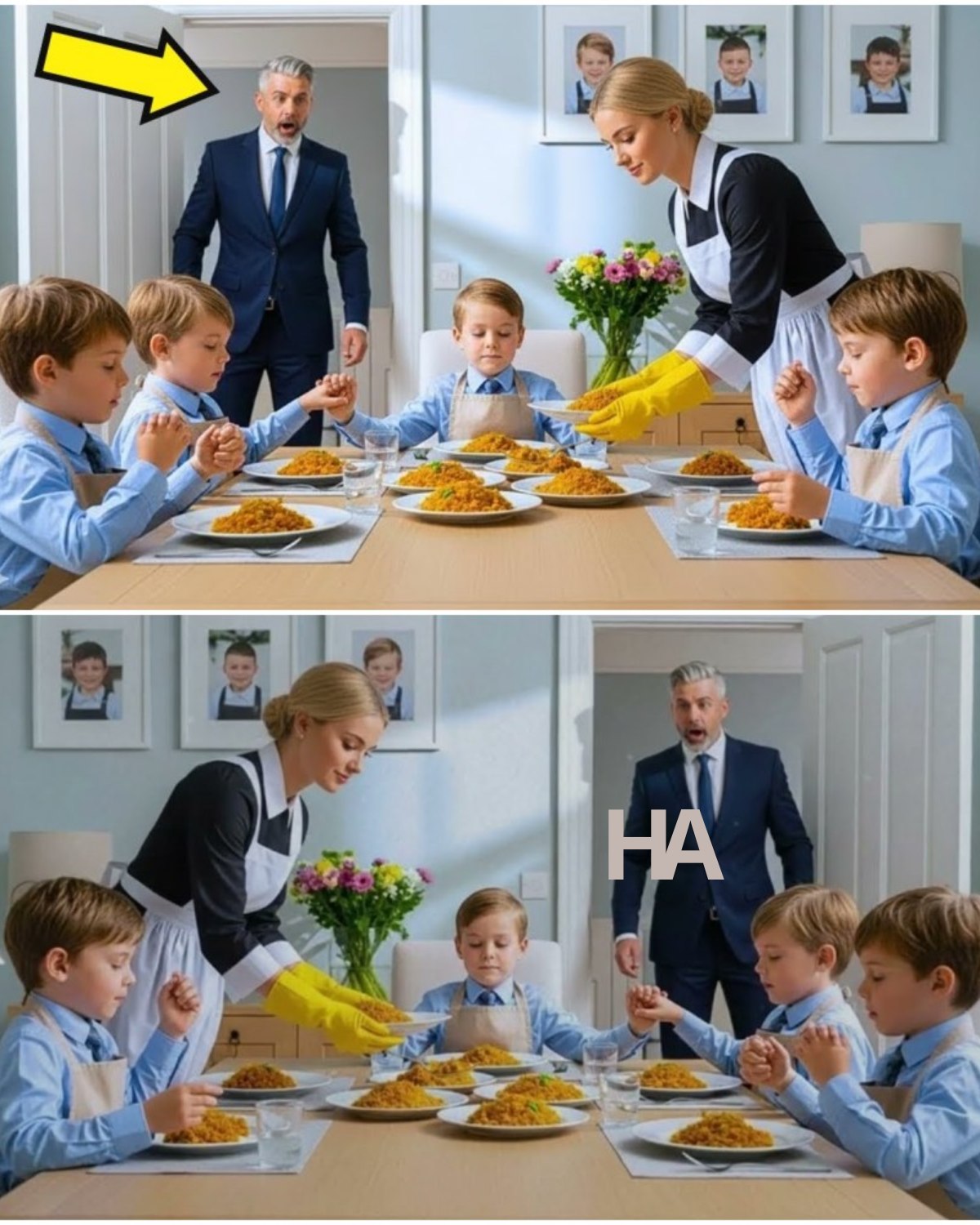
At the long imported mahogany table—unused since his wife’s funeral five years ago—life had returned.
Real life.
Elena, the young housekeeper barely twenty years old, dressed in her spotless blue-and-white uniform, wasn’t dusting or polishing silver.
She was sitting.
And she wasn’t alone.
Around the table—on chairs once reserved for diplomats and powerful business partners—sat four children.
Four identical boys.
Alejandro blinked.
Once.
Twice.
They couldn’t have been more than four years old.
They wore simple blue shirts that felt disturbingly familiar, as if pulled straight from Alejandro’s own childhood, and makeshift light aprons tied around their small chests.
Four copies.
Four reflections.
Messy brown hair.
Wide, expressive eyes fixed on the young woman in front of them.
“Open wide, my little birds,” Elena whispered softly.
The sound of her voice hit Alejandro harder than any insult ever had.
She held a large spoon filled with steaming yellow rice—simple, humble food that violently clashed with the fine porcelain and crystal surrounding it.
It wasn’t rich people’s food.
It was survival food.
Yet the boys stared at it like it was gold.
With practiced precision, Elena served each plate carefully, making sure every portion was exactly the same.
“Eat slowly,” she said gently. “There’s enough for everyone today.”
She reached out and stroked the head of the boy closest to her.
Her hands—still inside the yellow rubber gloves she used to scrub bathrooms—now touched small faces with a tenderness so deeply maternal that Alejandro’s throat tightened.
He should have exploded.
He should have stormed in, demanding to know who these strangers were, why they were touching his furniture, eating at his table, invading his carefully preserved solitude.
But he couldn’t move.
Something about the boys’ faces rooted him to the floor.
Then it happened.
The boy on the far left turned his head to laugh at something his brother did. The chandelier light caught his profile.
Alejandro’s world tilted.
That nose.
The curve of the lips when smiling.
Even the way the child held his fork—with an elegance no torn clothes could teach.
It was like looking into a warped mirror.
A mirror that dragged him forty years into the past.
His heart slammed against his ribs, wild and painful, like a trapped animal.
Who were they?
Where had they come from?
His mansion was a fortress—high walls, cameras, alarms. No one entered without his approval.
And yet here they were.
Four tiny intruders.
Eating yellow rice at his forbidden table.
Served by his employee as if they were hidden royalty from a forgotten kingdom.
One of the boys suddenly looked up.
Straight at him.
Their eyes met.
The child froze… then smiled.
A slow, innocent smile.
“Elena,” the boy said, pointing toward the doorway, “is that the man from the picture?”
The spoon slipped from Elena’s hand.
It clattered against the plate.
She turned.
Her face drained of color the moment she saw Alejandro standing there.
Time stopped.
The air thickened.
Alejandro felt something crack inside his chest.
“What… is this?” he finally managed to say, his voice barely a whisper.
Elena stepped back instinctively, positioning herself in front of the children.
“I can explain,” she said, trembling.
But Alejandro wasn’t listening anymore.
His eyes were locked on the four boys.
On the faces that looked far too familiar.
On the past he thought he had buried.
And for the first time since his wife died, Alejandro realized something terrifying:
His house hadn’t been empty all these years.
It had been waiting.
Alejandro took one slow step forward.
The children instinctively drew closer together, four small shoulders touching. Elena’s hands trembled, but she didn’t move away. She stood like a shield—thin, young, terrified, yet unyielding.
“From the picture?” Alejandro repeated hoarsely. “What picture?”
No one answered.
The silence pressed down on the room until even the chandelier seemed to hold its breath.
Finally, Elena swallowed. “The… the photo in the staff quarters,” she said. “The one in the silver frame.”
Alejandro felt a cold wave wash over him.
That frame.
He knew it well.
It held the only photograph he kept of himself and Sofia—his wife—taken before the sickness hollowed her cheeks, before the laughter faded from their home. He had locked that image away like a wound that never healed.
“And why,” he asked slowly, every word measured, “do children know my face?”
One of the boys tugged gently at Elena’s apron.
“It’s okay,” the child said, looking up at her. “You said he was kind.”
Alejandro’s knees nearly buckled.
Kind.
No one had used that word for him in years.
Elena closed her eyes briefly, as if surrendering to the inevitable. Then she turned back to Alejandro.
“They’re not intruders,” she whispered. “And they didn’t choose this.”
Alejandro’s jaw tightened. “Then start talking.”
She nodded.
“Four years ago,” Elena began, voice shaking, “I found them outside the old maternity clinic near San Martín Street. The one that closed suddenly.”
Alejandro’s breath caught.
That clinic.
Sofia had gone there during her final months. He remembered the arguments—the secrecy, her insistence on going alone, her quiet tears when she thought he wasn’t looking.
“They were newborns,” Elena continued. “Left in identical blankets. No names. No papers. Just… four babies.”
The boys listened silently, as if they’d heard the story many times.
“I was eighteen,” Elena said. “I had nothing. But I couldn’t leave them.”
Alejandro stared at the children, his chest tightening with every word.
“And the picture?” he demanded.
Elena hesitated, then spoke the truth he already felt clawing its way out of him.
“They asked who their father was.”
Alejandro’s vision blurred.
“I didn’t lie,” she said softly. “I showed them the only man connected to their birth records. The only name that appeared anywhere.”
Alejandro staggered back, gripping the edge of the table.
“No,” he whispered. “That’s not possible.”
But his mind betrayed him—memories crashing back like a floodgate breaking.
Sofia’s sudden hope.
Her secretive appointments.
Her whispered words one night, when she thought he was asleep:
“If something happens to me… promise you won’t let them be alone.”
At the time, he’d thought grief had already begun to confuse her.
Now, the truth stood before him.
Four times over.
One of the boys stood up from his chair and walked toward Alejandro, tiny steps echoing against marble.
“You don’t look scary,” the child said matter-of-factly. “Just sad.”
Alejandro dropped to his knees.
For the first time since losing Sofia, he cried—not the silent, controlled tears of a powerful man, but the broken sobs of a father who had missed four years of first words, first steps, first laughs.
Elena covered her mouth, tears streaming down her own face.
“I was scared,” she whispered. “I thought you’d take them away… or worse.”
Alejandro looked up at her, eyes red, voice raw.
“You brought life back into a dead house,” he said. “You fed my sons at my table.”
Sons.
The word settled into the room like a blessing.
He turned to the boys, opening his arms without realizing it.
“Come here,” he said gently. “All of you.”
They didn’t hesitate.
Four small bodies rushed into his embrace, awkward, warm, real.
And in that moment, Alejandro understood the truth that would change everything:
His fortune had never been his legacy.
They were.