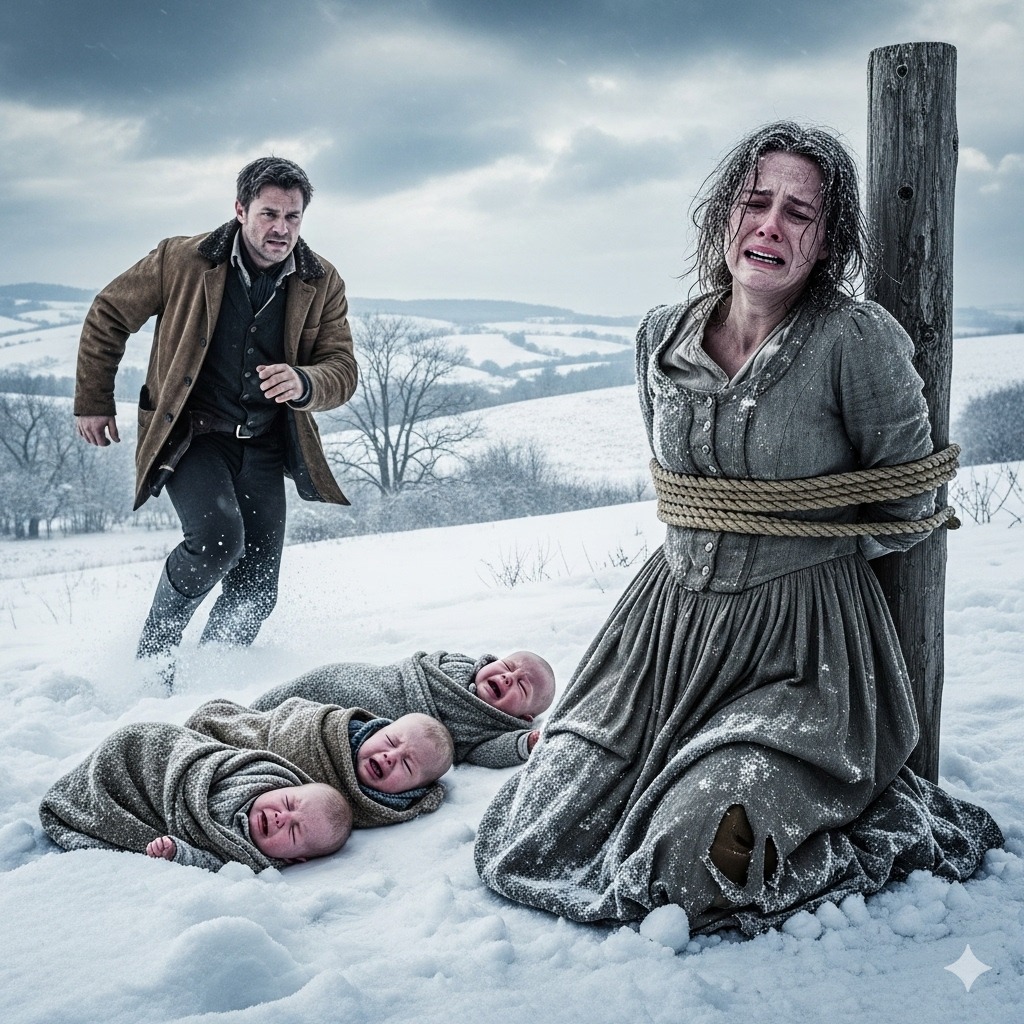
Silas took the ridge at a slant, keeping the trees between them and the worst of the wind. He moved the way men do when they’ve learned that hurry wastes breath—steady, counting steps, listening to the horse’s feet and the babies’ thin sounds under his coat. The woman’s head lolled against his shoulder. Once, she stirred.
“They said… girls ain’t worth feed,” she murmured, words fraying. “Said three was a curse.”
Silas said nothing. He shifted the blanket higher, felt the smallest chest flutter like a trapped bird, and kept climbing.
The cabin came out of the snow at last—a low log box crouched against the hill, smoke stitched thin into the sky. He shouldered the door, kicked it shut, and set the world to rights as best a man could: fire first, then light. He laid the woman on his bed, cut the frozen cloth from her wrists, washed the wire bites with warmed water and whiskey, bound them clean. He rubbed the babies’ feet with lard until color crept back like dawn.
When the kettle sang, he spooned sugar water into the infants’ mouths, drop by careful drop. Two found their voices again. The third stayed quiet longer, eyes closed, breath a whisper. Silas watched her the way he’d watched calves in bad springs—patient, unblinking, willing life forward by stubbornness alone.
She breathed. Then cried.
Silas let out the breath he’d been holding since the ridge.
The woman woke near morning. The storm had moved on; the cabin ticked as logs warmed. She tried to sit and failed.
“Easy,” Silas said, handing her broth. “Name?”
“Mary,” she said. Her eyes went to the cradle he’d knocked together from a flour box and rope. Three heads, dark as ink, lay side by side. “They took me out after,” she said, voice flat. “Their pa and his brothers. Said the fence post’d teach me.”
Silas’s jaw set. He stirred the fire instead of answering.
“Where am I?” she asked.
“Snowhorns. My place.” He met her gaze then. “You and the girls can stay.”
Mary studied him, measuring the words for traps. “Why?”
He shrugged. “Cabin’s quiet. Needs noise. And I don’t abide men who lash women to posts.”
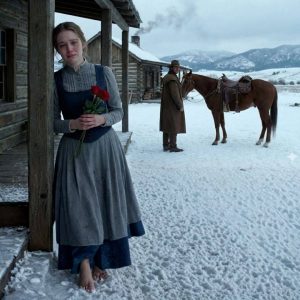
Days stitched themselves together. Mary healed slow; the wire had bitten deep. Silas cooked and fetched and learned the grammar of three infants—who wanted warmth, who wanted movement, who wanted a finger to grip as if it were the whole world. He made snowshoes smaller and a cradle bigger. He talked to the girls while he worked, told them about elk trails and the way weather changes its mind.
Mary watched. Trust came like spring in the high country—late, careful, undeniable.
When the thaw came, so did trouble. Hoofbeats one afternoon, too many. Silas set the rifle by the door and stepped out.
Three men reined in. One dismounted—the father. He wouldn’t look at the cabin windows.
“We come for what’s ours,” he said.
Silas didn’t raise the rifle. He rested a hand on it. “You won’t find it here.”
The man spat. “You ain’t kin.”
Silas’s voice stayed even. “You gave up kin when you tied a woman to wire and left babies to freeze.”
Wind moved the grass. A hawk cried. The men shifted, uneasy.
“Leave,” Silas said. “Or I’ll put you down and sleep easy.”
They left.
That night, Mary stood at the door with the girls bundled tight. “I can’t pay,” she said.
Silas looked at the three faces, identical as coins fresh struck, and then at Mary—straight-backed now, eyes clear. “Don’t need paying.”
Spring came. Then summer. The girls learned the smell of hay and the sound of Silas’s boots. They learned that hands could be gentle, that names could be spoken like blessings. Mary learned to laugh again, soft at first, then full.
Years later, folks said Silas Granger found a family in the Snowhorns. Silas said the Snowhorns gave him one. And if anyone asked why he’d taken in a beaten woman and three baby girls, he’d only shrug and say:
“Because they were cold. And because someone had to.”